Choosing a chiller is easy to get wrong, because the number on the box rarely tells you how a machine will behave on your floor. So why choose a 2 Ton Industrial Air Chiller Unit for your plant? At Tongwei we have spent more than 15 years building refrigeration equipment, and this small air-cooled class is the one we recommend again and again for single-machine cooling. This article explains what is actually inside the unit, what "2 ton" means in real numbers, and how we size it against a process instead of against a catalogue.
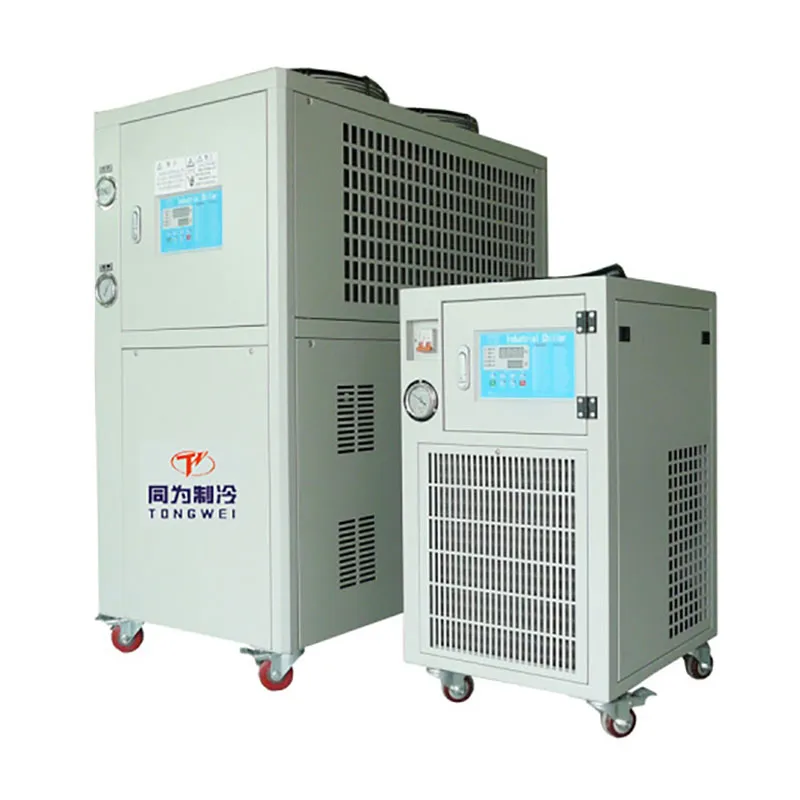
The Short Answer: Why This Size Works
Three reasons, in the order we give them to a plant engineer. First, a 2 ton class unit is compact enough to sit right next to the machine it serves, so you avoid the pipe runs, pumps and commissioning of a central chilled-water system. Second, it covers the most common single-machine loads — one injection moulding press, one laser, one vacuum coater — without paying for capacity you will never use. Third, point-of-use cooling gives tighter temperature control where it matters, which is why our injection moulding chillers and laser chillers are built in this range.
We do not push this size for everything. If you are cooling a whole plant or a high-heat process, a larger unit or a screw chiller is the right answer. But for a single machine that needs stable water at a predictable temperature, the 2 Ton Industrial Air Chiller Unit is usually where we start.
What "2 Ton" Actually Means in Numbers
Here is the clarification we give every buyer, because it earns trust and avoids an unpleasant surprise at commissioning. The model is sold as a "2 Ton 8KW" unit, but the published specification gives 2.39 ton at 50Hz and 2.75 ton at 60Hz. The cooling capacity is 8.39 kW (7,216 kcal/h) on a 50Hz supply and 9.82 kW (8,442 kcal/h) on 60Hz. The same nameplate therefore describes a slightly different machine depending on the grid it is connected to.
The ton is a legacy unit of refrigeration capacity, and it sits alongside kW, kcal/h and Btu/h on specification sheets. For reference, 1 ton equals 3.517 kW, 1 kW equals 860 kcal/h, and 1 kW equals 3,412 Btu/h. When customers compare our sheet with an imported unit using different units, we convert rather than argue about labels.
The Specification Sheet We Build To
This is the configuration of the TW-3A as we supply it. We publish these numbers because a specification sheet is a promise — if a value matters to your process, it should be written down before the order, not discovered after delivery. The full detail is also on our 2 Ton 8KW product page.
| Item | Specification | Why it matters |
|---|---|---|
| Model | TW-3A | The reference for spares and technical support |
| Cooling capacity | 8.39 kW @50Hz / 9.82 kW @60Hz | 2.39 ton / 2.75 ton respectively |
| Chilled water range | 5–35 °C | Covers most process cooling set points |
| Max power consumption | 2.85 kW; full-load current 7.2 A | Used for electrical planning |
| Power supply | 3PH-380V-50Hz standard; 208–480V-60Hz customised | Must match the destination grid |
| Refrigerant | R22 / R407C / R410A / R134A / R404A | Choose by regulation and application |
| Compressor | 3HP Panasonic hermetic scroll, 2.2 kW, one unit | Efficiency, noise and service life |
| Condenser | Aluminium finned copper sleeve + low-noise external rotor fan; 3,000 m³/h; fan motor 0.14×2 kW | Sets the heat-rejection and noise behaviour |
| Evaporator | Coil in stainless water tank (standard); SS plate type (custom) | Decides heat exchange and cleanability |
| Water pump | 0.37 kW; 5.4 m³/h; max pressure 2 bar | Check against your line pressure |
| Tank volume | 50 L | Buffer stability on small loads |
| Inlet / outlet | 3/4 inch BSP | Match to existing pipework |
| Cooling water flow | 1.44 m³/h | Design figure for the chilled loop |
| Dimension / weight | 990 × 530 × 1180 mm / 160 kg | Planet and floor-loading check |
| Temperature stability | ±0.1 °C to ±2 °C | Depends on load and control option |
| Warranty | 12 months, free spare parts and technical support | What we stand behind after delivery |
The Five Parts That Decide Reliability
A chiller is only as good as the components inside it. We are explicit about what we fit, because two units with the same capacity on paper can behave very differently after two years of running.
Compressor. The 2 ton unit uses one 3HP Panasonic hermetic scroll compressor. We chose scroll for its high refrigeration efficiency, low noise and stable operation. It is the component that creates the pressure difference driving the refrigerant, and it is the first thing we ask about when a unit comes back for service.
Evaporator. This is where heat is taken out of the water. We offer a coil in stainless steel water tank as standard, with a 304 stainless plate type or shell-and-tube version for customers who need a different flow or easier cleaning. The right choice depends on water quality and the process, not on which option costs more.
Water pump. Standard pressure is about 2 bar. If you are cooling a bottle blowing machine or a line with a long vertical run, you may need around 4 bar — tell us at enquiry and we will fit a high-pressure pump rather than letting you discover the shortfall on site.
Condenser. Efficient cross-seam fins with female-threaded copper tubes give good heat exchange and stability, paired with a low-noise external rotor fan. This is why the room needs ventilation: the condenser's job is to dump heat into the air.
Controller panel. A precision digital temperature controller with an RS485 communication port allows remote monitoring and control. Simple operation and a low failure rate matter more than a complicated menu that nobody learns to use. Replacement items are listed under our chiller spare parts range.
Matching Capacity to Your Process
The most useful thing we can do for a buyer is help them avoid buying the wrong size. Too small and the water never reaches set point on a hot day; too large and the unit short-cycles, wastes energy and wears the compressor. We use the same calculation in every enquiry.
| Step | Formula or rule | Example: 10 m³ from 35 °C to 15 °C in one hour |
|---|---|---|
| 1. Temperature difference | T1 − T2 | 35 − 15 = 20 °C |
| 2. Cooling capacity | Flow (m³/h) × ΔT ÷ 0.86 | 10 × 20 ÷ 0.86 = 232 kW |
| 3. Add safety margin | Ideal size = kW × 1.2 | 232 × 1.2 = 278.4 kW |
| 4. Translate to units | 1 ton = 3.517 kW; 1 kW = 860 kcal/h | Confirms the size class against the product sheet |
For the 2 ton class the practical question is simpler: does one machine's heat load fit within roughly 8–10 kW? If it does, a point-of-use unit is usually more economical than a central system. If it does not, we will say so. Our note on compact air-cooled chillers explains where this approach works best, and the 5HP EDM installation is a good smaller-scale example.
Where a 2 Ton Unit Earns Its Keep
We would rather show the application map than make a generic promise. The units below are the ones we most often match to this capacity, and the reasoning is the same whether the customer is in plastics, printing or metal finishing.
| Application | Fit | Our reasoning |
|---|---|---|
| Plastic injection moulding | Best fit | Single-press load, point-of-use placement, stable mould temperature |
| Laser cutting and welding | Best fit | Compact footprint and tight temperature stability protect the source |
| Printing and pouch making | Good | Keeps rollers and ink within a consistent temperature band |
| Vacuum coating and capping machines | Good | Reliable cooling where a central loop would be overkill |
| Metal polishing and finishing | Good | Handles a steady load without a large water treatment setup |
| CNC and oil cooling | Good, check pressure | Confirm pump pressure against the machine's requirement |
| Food and beverage processing | Case by case | Material and hygiene options must be agreed before quoting |
| Whole-plant or multi-machine cooling | Not this unit | A larger packaged or screw chiller is the correct choice |
Neighbouring sizes in our range include the 1 ton small chiller for lighter loads and the 12 ton process chiller for larger lines. We also write about how a 3 ton packaged unit and a 6 ton vacuum-pump system are specified.
Installation: Indoors or Outdoors
One of the practical advantages of an air-cooled unit is flexibility of placement. It can be installed indoors if there is a proper ventilation system to carry the rejected heat away, or outdoors where heat can be released directly into the air. We configure the electric panels according to ambient temperature, because a unit sitting in a hot plant room is a different proposition from one in a shaded outdoor corner.
The number to respect is the condenser airflow of 3,000 m³/h. If the room cannot move that air, the condenser will struggle and the compressor will work harder for the same cooling. This is not a defect — it is physics — and it is why we ask about the installation space before we confirm an order. For plants that want a single skid with everything pre-assembled, our note on the skid-mounted integrated chiller covers that option.
Controls, Protection and Service Access
The controller is more than a display. The precision digital unit with RS485 lets a plant monitor and adjust the chiller remotely, and its simple operation keeps the failure rate low. Temperature stability is specified between ±0.1 °C and ±2 °C depending on the load and the control approach — we will tell you which figure applies to your process rather than quoting the best number in the range.
Protection is comprehensive: compressor overheating, over-current, high and low pressure, over-temperature, flow, phase sequence and phase loss, low water level and frost protection. The value of these is that a problem stops the machine safely instead of quietly damaging the compressor. When something does need attention, the standard components and clear layout make service straightforward, and our technical downloads give maintenance teams the documentation they need.
The Honest Trade-offs of Air Cooling
We will not pretend air cooling is always the answer. An air-cooled 2 ton unit is self-contained, needs no cooling tower and is straightforward to install — that is why it suits a small plant or a single machine. The trade is that it rejects heat into the surrounding air, so ambient conditions matter and the noise stays in the workspace. In a hot, crowded plant, water cooling can hold a more stable condenser temperature.
Our position is simple: if your process is one machine with a modest load and you want a low-maintenance installation, air cooled is the sensible choice. If you are running several machines or the room is genuinely hot, we will point you toward a water-cooled option instead of selling you the wrong thing. That judgement comes from seeing where units are installed, not from a product folder.
What Tongwei Stands Behind
Guangdong TongWei Refrigeration Machinery Co., Ltd. was founded in 2011 and brings together research and development, design, manufacture, sales and service for refrigeration equipment and energy-saving systems. We build chillers from 1/2 ton to 500 ton, cover industrial air-cooled, water-cooled, screw, glycol, low-temperature, explosion-proof and portable ranges, and hold CE certification on the relevant lines. More detail is on our about page.
Every unit comes with a 12 month warranty including free spare parts and full technical support, and we size each machine against the actual process rather than shipping a catalogue model. Our wider air-cooled chiller range and industry news show how we approach other cooling problems. We are looking for long-term supply relationships, which is why we answer the difficult questions early.
Frequently Asked Questions
1. Why choose a 2 Ton Industrial Air Chiller Unit for a plant?
A 2 ton class unit is small enough to install close to the machine yet powerful enough for the common single-machine loads in injection moulding, laser cutting, printing and vacuum coating. It avoids the cost of a central chilled-water system while giving tighter temperature control at the point of use.
2. Is the TW-3A really a 2 ton chiller?
It is sold as a 2 ton 8KW unit, but the published specification gives 2.39 ton at 50Hz and 2.75 ton at 60Hz, with cooling capacity of 8.39kW and 9.82kW respectively. We always quote the capacity at the frequency you will actually run, because a 60Hz supply delivers noticeably more cooling than a 50Hz one.
3. Can I install this air chiller unit indoors?
Yes, provided there is proper ventilation to reject heat, or outdoors where heat can be released into the air. The condenser uses an aluminium finned copper sleeve with a low-noise external rotor fan, so the room needs enough air movement for the 3000 m3/h airflow.
4. How do I calculate the cooling capacity I need?
Use Cooling Capacity (kW) = Flow Rate (m3/h) x Temperature Difference / 0.86, then oversize by about 20 percent. For example, cooling 10 m3 of water from 35C to 15C in one hour needs 10 x 20 / 0.86 = 232 kW, or roughly 278 kW after the 20 percent margin.
5. What refrigerants and power supplies are available?
The unit supports R22, R407C, R410A, R134A and R404A. Standard power is 3PH-380V-50Hz, and we customise 208-480V at 60Hz for other markets. Tell us your grid and refrigerant preference at enquiry stage.
6. What warranty and support does Tongwei provide?
Every chiller carries a 12 month warranty including free spare parts and full technical support. Tongwei has more than 15 years of refrigeration experience, and we size each unit against the actual process rather than shipping a catalogue model.
Talk to Our Team
Need help sizing a chiller for your machine?
Tell us the process, the inlet and target water temperatures, the flow you need and your power supply. We will confirm whether the 2 Ton Industrial Air Chiller Unit is the right fit, or point you to a different size. You can contact our team or leave a message, and we will reply within 24 hours.