Copyright © 2023 Guangdong Tongwei Machinery Co., Ltd. All Rights Reserved.
Links Sitemap RSS XML Privacy Policy
Industrial cooling systems are increasingly expected to provide stable temperature control without adding unnecessary complexity to a production facility. For smaller manufacturing lines, laboratory equipment, processing machines, and other heat-generating applications, an oversized central cooling system can create higher installation and operating requirements than necessary.
This is why packaged air-cooled chillers remain a practical option for process cooling. By integrating the main refrigeration components into a compact system, they can provide chilled water without requiring a separate cooling tower. For manufacturers and equipment integrators, this can simplify installation while keeping the cooling system relatively easy to operate and maintain.
The 3 Ton Industrial Packaged Air Cooled Chiller from TONGWEI is designed for this type of application. Model TW-4A provides a cooling capacity of 10.8 kW at 50 Hz and 12.96 kW at 60 Hz, with a standard 380V/50Hz/3Ph power supply and customized 208–480V/60Hz/3Ph configurations available.
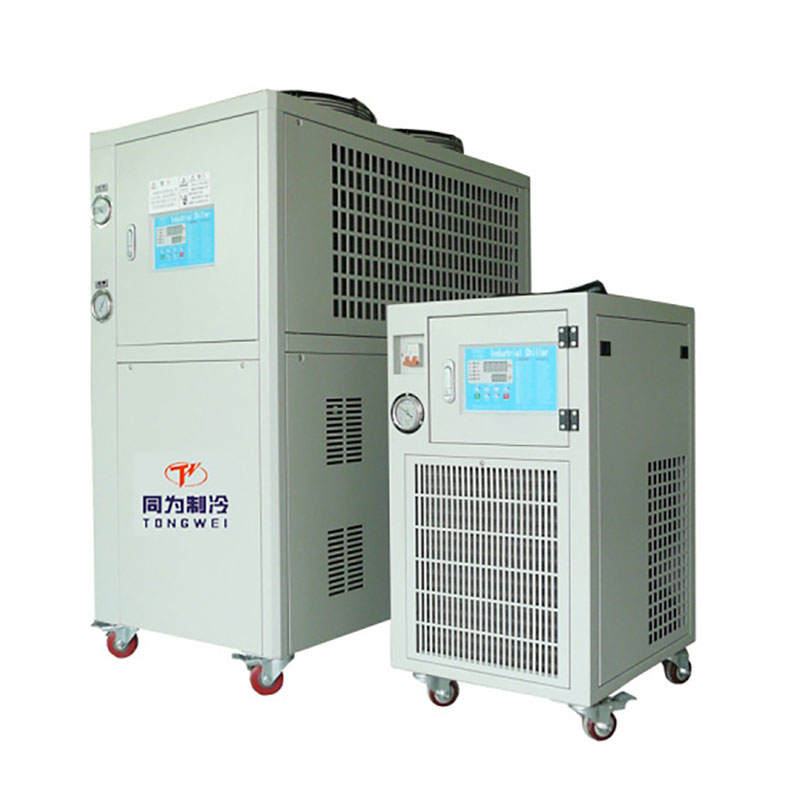
Traditional water-cooled systems typically require additional equipment such as a cooling tower and cooling-water pump. An air-cooled packaged chiller rejects heat directly to the surrounding air through its condenser and fan system.
This configuration can reduce the number of auxiliary components that need to be installed. It is particularly useful for factories or workshops where installation space, water availability, and system complexity are important considerations.
Industrial machines often generate heat continuously during operation. Maintaining the temperature of process water within an appropriate range can help prevent excessive thermal buildup and support stable machine performance.
A packaged chiller provides a dedicated cooling source that can be connected to suitable process equipment or circulating-water systems. The exact cooling capacity required should be determined from the machine's heat load, operating conditions, ambient temperature, and required water temperature.
| Parameter | Specification | Procurement Significance |
|---|---|---|
| Product Type | Industrial packaged air-cooled chiller | Integrated process cooling solution |
| Model | TW-4A | Standard model identification |
| Nominal Capacity | 3 Ton | Suitable for smaller industrial process cooling requirements |
| Cooling Capacity | 10.8 kW / 9288 kcal/h @ 50Hz | Reference capacity under 50Hz operating conditions |
| Cooling Capacity | 12.96 kW / 11146 kcal/h @ 60Hz | Reference capacity under 60Hz operating conditions |
| Power Supply | 380V / 50Hz / 3Ph | Standard industrial electrical configuration |
| Customized Power | 208–480V / 60Hz / 3Ph | Supports different international electrical requirements |
| Compressor | Panasonic scroll compressor | Scroll compression technology for refrigeration applications |
| Refrigerant Options | R22 / R407C / R410A / R134A / R404A | Refrigerant selection should match system and market requirements |
| Standard Evaporator | Coil in stainless steel water tank | Suitable for standard circulating-water cooling |
| Customized Evaporator | Shell and tube | Provides an alternative heat-exchange configuration |
| Cooling Method | Air cooled | Does not require a cooling tower for heat rejection |
| Warranty | 12 months | Includes free spare parts and technical support according to supplier terms |
The published specifications identify TW-4A as a 3-ton industrial packaged air-cooled chiller. Actual cooling performance depends on operating conditions such as ambient temperature, inlet and outlet water temperature, flow rate, refrigerant configuration, and electrical frequency. Buyers should confirm the final operating conditions before selecting the unit.
In an industrial cooling loop, warm process water enters the evaporator and transfers its heat to the refrigerant. The cooled water is then circulated back to the equipment that requires temperature control.
The process repeats continuously as long as the cooling system is operating. This closed-loop approach allows the same cooling medium to circulate through the process rather than requiring a constant supply of fresh cooling water.
After absorbing heat from the process water, the refrigerant transfers that heat to the condenser. In an air-cooled system, fans move ambient air across the condenser to release the heat outside the refrigeration circuit.
This is the fundamental difference between air-cooled and water-cooled heat rejection. Air-cooled systems can eliminate the need for a cooling tower and associated cooling-water equipment, which can simplify installation in suitable environments.
The TW-4A configuration uses a Panasonic scroll compressor. Scroll compressors are widely used in refrigeration and air-conditioning applications because of their compact structure and continuous compression process.
For industrial buyers, compressor selection should be considered together with the required cooling capacity, operating temperature, refrigerant, electrical supply, and expected duty cycle.
Choosing a chiller simply according to the nominal machine tonnage can lead to an unsuitable system. The actual process heat load should be calculated before procurement.
Factors such as the power consumed by the cooled machine, heat transferred into the process fluid, operating time, ambient temperature, and required temperature difference can all influence the required cooling capacity.
Plastic injection molding and extrusion processes can generate significant heat that needs to be removed to maintain stable operating conditions. Chilled water can be used for suitable machine components, molds, hydraulic systems, or auxiliary process equipment.
A dedicated packaged chiller can provide a controlled cooling source without requiring the factory to install a large centralized refrigeration system.
Laser systems and precision processing equipment may require stable cooling to manage heat generated during operation. The appropriate coolant temperature and flow rate depend on the equipment manufacturer's requirements.
For these applications, buyers should verify temperature stability, water quality requirements, flow rate, and heat load before selecting the chiller.
Cooling is required in various food and beverage processes, including equipment cooling, fermentation-related processes, and temperature control of production systems.
The chiller configuration should be selected according to the specific process, hygienic requirements, coolant type, and temperature range rather than assuming that one configuration is suitable for every application.
Chemical production can involve heat-generating reactions and equipment that require controlled cooling. A packaged industrial chiller can serve as an independent cooling source for suitable process loops.
When used in chemical environments, the materials of the heat exchanger, coolant compatibility, ambient conditions, and required safety measures should be evaluated carefully.
One of the main practical advantages of an air-cooled packaged chiller is the reduced requirement for external heat-rejection equipment. There is no need for a separate cooling tower and cooling-water pump for the standard air-cooled configuration.
This can make the system easier to integrate into facilities where space is limited or where installing additional water-side infrastructure would be inconvenient.
Air-cooled chillers can be installed outdoors when the equipment specification and ambient conditions permit. Outdoor installation can help free up valuable indoor factory space.
However, adequate airflow around the condenser is essential. The installation location should prevent hot discharge air from recirculating back into the condenser, as excessive ambient temperatures can reduce refrigeration performance.
The first step is determining how much heat the chiller needs to remove. Buyers should provide the supplier with the equipment heat load, desired inlet and outlet water temperatures, water flow rate, operating hours, and ambient conditions.
These details allow the supplier to confirm whether a 3-ton configuration is appropriate or whether a different capacity would provide better operating margins.
The standard TW-4A configuration uses 380V/50Hz/3Ph power, while customized 208–480V/60Hz/3Ph configurations are available.
International buyers should confirm local voltage, frequency, phase, plug or electrical connection requirements, and applicable electrical standards before placing an order.
The standard configuration uses a coil in a stainless steel water tank, while a shell-and-tube evaporator can be customized.
The choice depends on the process fluid, required flow rate, operating conditions, maintenance preferences, and heat-transfer requirements. Buyers should provide complete process information when requesting a customized configuration.
The published product information lists R22, R407C, R410A, R134A, and R404A as refrigerant options. Refrigerant selection is subject to the final system design, applicable regulations, availability, and destination-market requirements.
Importers should confirm the exact refrigerant supplied with the selected model rather than assuming that every option is included in one standard machine.
Because an air-cooled chiller relies on ambient air to reject heat, dust and debris accumulating on the condenser can restrict airflow and reduce heat-transfer efficiency.
Regular inspection and cleaning should therefore form part of the maintenance schedule, particularly in dusty industrial environments.
The chiller should be installed with sufficient clearance around the air inlet and discharge areas. Blocking airflow or installing the unit in a poorly ventilated location can increase operating temperatures.
Where multiple chillers are installed together, their exhaust airflow should also be considered to avoid hot-air recirculation.
The process-water circuit should be maintained according to the requirements of the chiller and the connected equipment. Poor water quality can contribute to deposits, corrosion, or reduced heat-transfer performance.
Flow rate and water temperature should also be monitored so that abnormal operating conditions can be identified early.
An industrial chiller is not an isolated appliance. Its performance depends on correct sizing, installation, electrical connection, water circulation, ventilation, and operating conditions. Supplier support is therefore an important part of the purchasing decision.
TONGWEI is associated with industrial air-cooled and water-cooled chiller systems, offering cooling capacities across a broad range. The company's published product information states that its industrial chiller range covers applications in plastic processing, medical, brewery and winery, chemical, food, and other industries.
The manufacturer also states that it has more than 15 years of experience in chiller design and manufacturing and provides 12-month warranty support for its industrial chillers. Buyers should confirm the exact warranty scope, spare-parts policy, commissioning support, and service terms for the specific model before purchase.
TONGWEI provides different industrial chiller configurations, including air-cooled, water-cooled, glycol, portable, low-temperature, oil, and customized systems. This range allows cooling capacity and system structure to be matched more closely with individual process requirements.
For international projects, customization can be particularly useful because electrical standards, refrigerant requirements, ambient temperatures, process-fluid conditions, and installation environments vary between markets.
Choosing a chiller should begin with the process rather than the equipment name. Buyers should first determine the actual heat load and required coolant temperature, then confirm the water flow, ambient temperature, electrical supply, installation location, and operating schedule.
Once these parameters are established, the refrigeration capacity and evaporator configuration can be selected more accurately. This approach reduces the risk of purchasing an undersized unit that cannot maintain the required temperature or an oversized system that adds unnecessary capital and operating costs.
For many industrial applications, the most useful cooling system is not necessarily the largest one. A properly sized packaged air-cooled chiller can provide a dedicated source of process cooling while avoiding the additional infrastructure associated with a water-cooling tower.
The 3 Ton Industrial Packaged Air Cooled Chiller from TONGWEI combines a 10.8 kW cooling capacity at 50Hz, scroll compressor technology, an integrated air-cooled condenser, stainless-steel water-tank evaporator, and flexible power and evaporator configurations.
For plastic processing, food production, chemical processing, laser equipment, and other industrial applications, the most important consideration is matching the chiller to the actual process conditions. By evaluating cooling load, temperature requirements, water flow, electrical compatibility, ventilation, and maintenance needs before procurement, industrial buyers can build a more reliable and practical cooling solution.
Copyright © 2023 Guangdong Tongwei Machinery Co., Ltd. All Rights Reserved.
Links Sitemap RSS XML Privacy Policy