Copyright © 2023 Guangdong Tongwei Machinery Co., Ltd. All Rights Reserved.
Links Sitemap RSS XML Privacy Policy
In modern different industrial production, industrial water chillers play a crucial role, providing stable low-temperature cooling for systems requiring temperature reduction. Among the four main components of a water chiller unit, the condenser, as a key component, plays an indispensable role. In this article, Tongwei Chiller will explain the function of the chiller condenser.
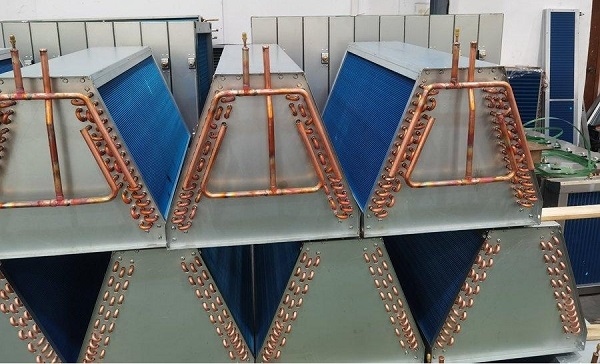
The refrigeration cycle of a water chiller is a complete process, with the condenser located on the high-pressure side. Its main working principle is based on heat transfer. When the high-temperature, high-pressure gaseous refrigerant from the compressor enters the condenser, it exchanges heat with the external cooling medium (usually air or water) inside the condenser. The cooling medium has a relatively low temperature, and the heat from the gaseous refrigerant is transferred to it, causing the gaseous refrigerant to gradually cool and liquefy.
For the condenser of air cooled chiller, the fan blows relatively cool outside air across the condenser's heat dissipation fins, where the airflow exchanges heat with the high-temperature gaseous refrigerant inside the fins, carrying away the refrigerant's heat;For the condenser of water cooled chiller, however, heat exchange occurs between the circulating cooling water and the refrigerant, carrying away the refrigerant's heat,which need water cooling tower.
This is the most important function of the condenser in a refrigeration system. In the refrigeration cycle, the compressor compresses the refrigerant, causing its temperature and pressure to rise rapidly. If this large amount of heat carried by the refrigerant is not dissipated in time, the entire refrigeration system will not function properly. The condenser, through heat exchange with the cooling medium, dissipates the heat generated by the refrigerant during compression, as well as the heat absorbed from the object being cooled, into the surrounding environment.For example, in chemical production, water chillers provide low-temperature cooling for reaction vessels, while condensers release the heat absorbed in the reaction vessel and the heat generated by the compression of the refrigerant to the outside, ensuring that the reaction takes place at a suitable temperature.
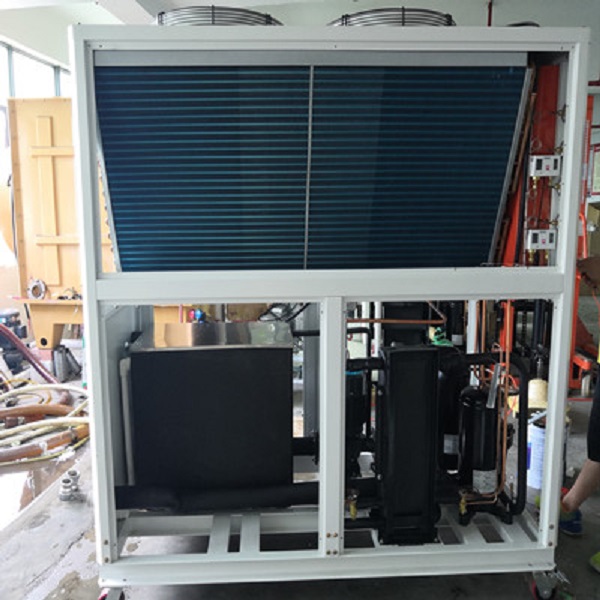
The condenser facilitates the transformation of the refrigerant from a gaseous to a liquid state. This state transition is crucial for the continuity of the entire refrigeration cycle. Only after the refrigerant is liquefied can it be depressurized and throttled through a throttling device (such as an expansion valve), becoming a low-temperature, low-pressure gas-liquid mixture. This mixture then enters the evaporator to absorb heat from the object being cooled, achieving the refrigeration effect. Without a condenser to liquefy the gaseous refrigerant, the refrigeration cycle would be interrupted, and the chiller would be unable to achieve its cooling purpose.
The condenser effectively reduces the volume of the refrigerant by cooling and liquefying it. According to the ideal gas law, at a given temperature and mass, a decrease in gas volume leads to a decrease in pressure. Therefore, the condenser's operation maintains the pressure on the high-pressure side of the refrigeration system within a reasonable range, ensuring stable system operation. Simultaneously, appropriate system pressure is also crucial for the normal operation of the compressor; excessively high or low pressures will affect the compressor's performance and lifespan.
A high-efficiency condenser can quickly and efficiently transfer heat from the refrigerant, allowing it to rapidly cool and liquefy. This ensures that the refrigerant entering the evaporator has a low temperature and suitable state, thereby improving the evaporator's cooling efficiency. If the condenser's heat dissipation is ineffective, the refrigerant cannot liquefy sufficiently, leading to a decrease in the evaporator's cooling capacity and affecting the overall cooling performance of the chiller. For example, in large data centers, chillers are used to cool servers. If the condenser does not work effectively, the data center's temperature cannot be effectively controlled, threatening the server's performance and stability.
Air-cooled type condensers are easy to install, don’t require additional cooling water circulation system, making them suitable for applications with limited water resources or where installing a cooling water system is difficult. However, their cooling effect is relatively inferior to water-cooled condensers, especially in high-temperature environments where the limited heat dissipation capacity of air can lead to a decrease in condenser efficiency. To ensure effective heat dissipation, a larger heat dissipation area and higher air velocity are typically required, which increases the size of the equipment and operating noise.
Water-cooled condensers offer superior cooling performance, achieving efficient heat transfer within a relatively small volume. They are suitable for applications requiring high refrigeration efficiency, such as large-scale industrial production and commercial refrigeration, and high ambient such as Saudi Arabia .However, water-cooled condensers require a cooling water circulation system, including cooling towers and water pumps, which increases initial investment and operating costs. Furthermore, regular cooling water treatment is necessary to prevent scale and corrosion damage to the condenser.
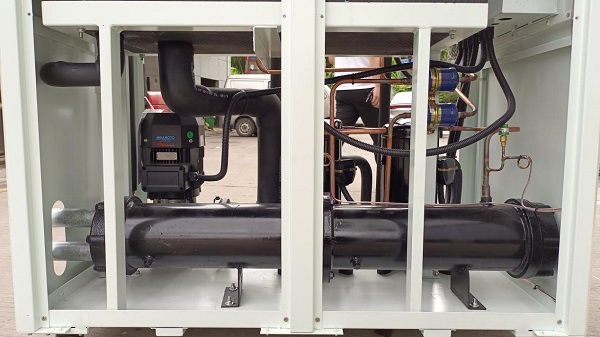
As a key component of a chiller, the condenser plays a crucial role in heat dissipation, refrigerant state transitions, maintaining system pressure balance, and ensuring cooling efficiency. Different types of condensers have their own characteristics. In practical applications, it is necessary to select the appropriate condenser type based on the specific usage scenario and requirements to ensure the chiller operates efficiently and stably, providing reliable cooling for industrial production and daily life. With continuous technological advancements, condenser technology is also constantly improving, and more efficient and energy-saving condensers will emerge in the future, further enhancing the performance and application range of chillers.If you want to know more information about chiller condenser ,welcome contact Tongwei Chiller by email :[email protected]
Copyright © 2023 Guangdong Tongwei Machinery Co., Ltd. All Rights Reserved.
Links Sitemap RSS XML Privacy Policy