Copyright © 2023 Guangdong Tongwei Machinery Co., Ltd. All Rights Reserved.
Links Sitemap RSS XML Privacy Policy
In industries such as industrial manufacturing, laser processing, pharmaceuticals, and food, water chillers are crucial for ensuring stable equipment operation and extending equipment lifespan. With the continuous development of energy-saving and intelligent technologies, water chillers have transitioned from the traditional "fixed-frequency era" to the "variable-frequency era." So, what are the differences between variable frequency and fixed frequency chillers, and how should one choose between them for your process? In this article,Tongwei Chiller will explore it.
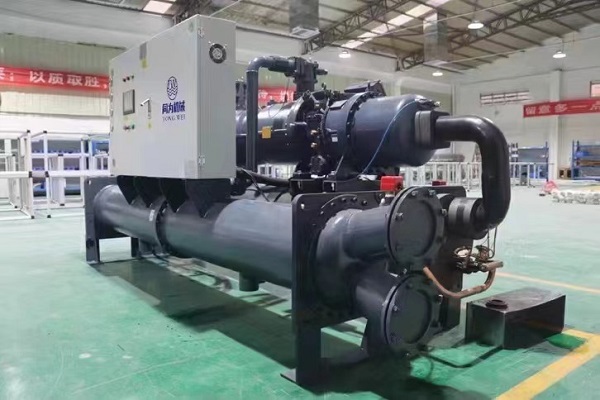
A variable frequency chiller is a cooling machine that uses variable frequency technology to adjust the compressor speed, thereby achieving on-demand cooling and precise temperature control. The chiller primarily uses a variable frequency controller to detect changes in cooling demand in real time and dynamically adjusts the compressor speed to achieve continuous output. Its core function is to automatically adjust the operating frequencies of the compressor, motor, and fan based on the real-time load of the equipment, ensuring the system always maintains optimal efficiency and It will not cause waste and environmental damage due to excessive operating power, nor will it cause inefficiency in system software due to insufficient operating power.
1. Energy-saving and efficient: Variable frequency chillers automatically adjust cooling power based on compressor status and operating temperature, avoiding energy waste caused by frequent start-stop cycles. This can save 20%-40% of electricity, achieving high-efficiency cooling.
2. Precise temperature control: Variable frequency control has a fast response speed and minimal temperature fluctuations, controllable within ±0.1℃, and under specific conditions, achieving a temperature control accuracy of ±0.01℃.
3. Quiet operation: Compared to traditional chillers, variable frequency chillers automatically adjust power in real time, and the equipment only operates when necessary, resulting in low noise.
4. Reliability: Compared to traditional electric motors, the motors in variable frequency chillers are more integrated, simplifying assembly and maintenance.
5.Longer Lifespan: Reduced mechanical shock and start-stop frequency improve system reliability and extend compressor lifespan;
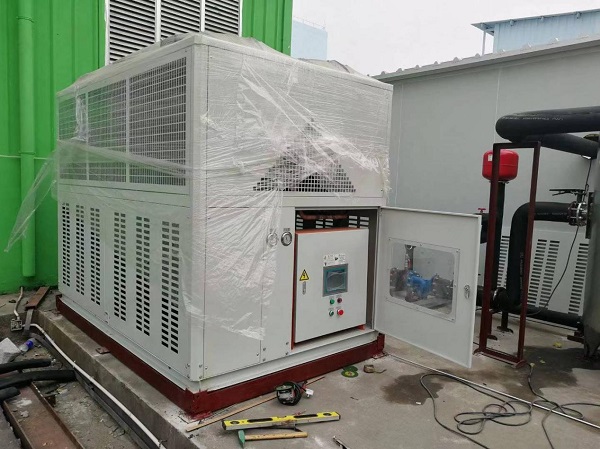
Slightly higher cost: The variable frequency system has a complex structure, resulting in a relatively large initial investment;
Higher maintenance requirements: Higher requirements for the stability of the circuit board and control system;
Environmental limitations: The variable chiller is more sensitive to power supply voltage fluctuations, requiring the use of a voltage stabilizing system.
A fixed frequency chiller is a cooling machine whose compressor operates at a fixed speed. Its main components, such as the compressor, fan, and water pump, all operate at a constant frequency (usually 50Hz), relying on start-stop control to regulate the cooling capacity and maintain the equipment temperature. Fixed-frequency chillers monitor the system temperature through a temperature controller:
●The compressor starts cooling when the temperature is higher than the set value;
●The compressor stops running when the temperature is lower than the set value.
This "start-stop-start-stop" cyclic control method is simple in structure and stable in operation, but it is not as good as the frequency converter system in terms of temperature control accuracy and energy efficiency.
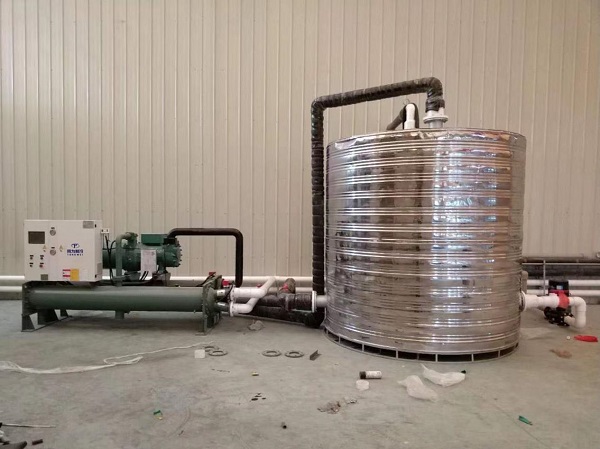
●Simple structure and low cost: The system design is mature, the components are highly interchangeable, and the manufacturing and maintenance costs are more advantageous;
●Stable operation and wide applicability: It does not rely on complex electrical control systems and can operate stably for a long time in various industrial environments;
●Convenient maintenance: Standardized components and highly interchangeable parts make it easy to repair and replace.
● High energy consumption: The compressor always runs at full load and will not automatically adjust even if the cooling demand is not high;
● Low temperature control accuracy: Start-stop control is prone to temperature fluctuations, generally controlled at around +2℃;
● Relatively short equipment lifespan: Frequent start-stop causes mechanical shock to the compressor, resulting in faster wear after long-term operation.
| Item | Variable Frequency Chiller | Fixed Frequency Chiller |
| Temperature control accuracy | ±0.1℃ | ±2℃ |
| Energy efficiency | High (energy savings of 20-40%) | General |
| Lifespan | Longer duration | General |
| Applicable scenarios | Precision equipment, variable load systems | Constant load; General cooling equipment |
| Early-stage timber | Higher | Lower |
| Load characteristics | Large user equipment load fluctuations | User equipment load is relatively stable |
Users should consider various factors based on their actual needs, budget, and sensitivity to operating costs to make a scientific and reasonable decision. They should also consider brand and after-sales service. Tongwei Chiller, as a professional industrial refrigeration solutions provider, not only covers a variety of inverter and fixed-frequency models in its product line, but also provides professional selection advice and technical support based on users' actual needs.Welcome contact Tongwei Chiller by email :[email protected].
Copyright © 2023 Guangdong Tongwei Machinery Co., Ltd. All Rights Reserved.
Links Sitemap RSS XML Privacy Policy