Copyright © 2023 Guangdong Tongwei Machinery Co., Ltd. All Rights Reserved.
Links Sitemap RSS XML Privacy Policy
Industrial cooling systems play a critical role in maintaining production efficiency, protecting machinery, and ensuring consistent product quality. Among various cooling technologies, the 25HP Industrial Packaged Water Cooled Chiller has become a preferred solution for factories requiring stable and energy-efficient temperature control.
This comprehensive guide explores how these chillers work, their advantages, application industries, maintenance requirements, energy-saving features, installation considerations, and buying tips. Whether you operate a plastics factory, food processing facility, pharmaceutical plant, or CNC machining workshop, this article will help you understand how the right chiller can transform your industrial operations.
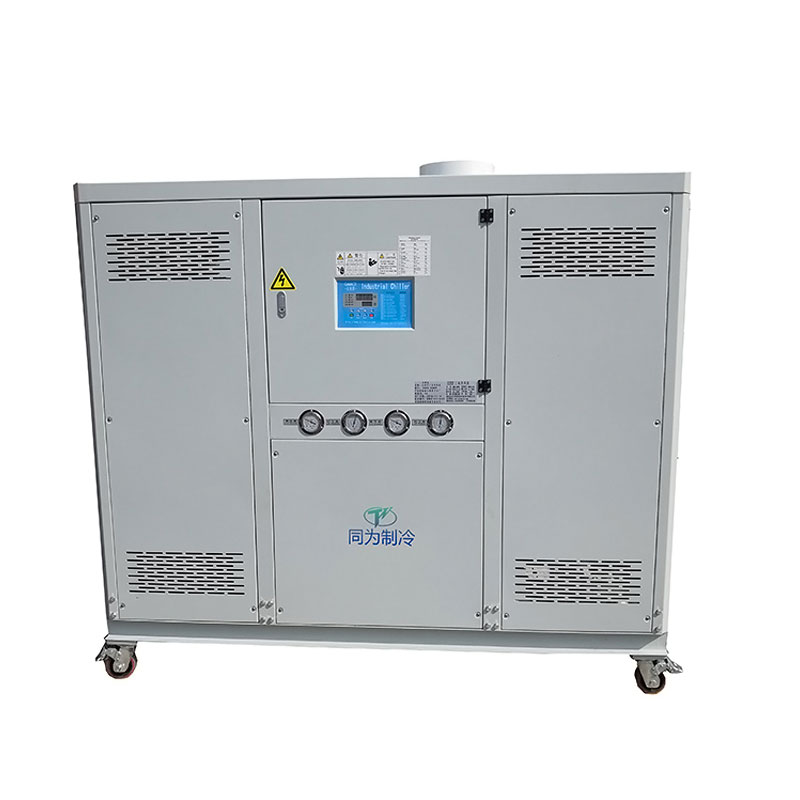
A 25HP Industrial Packaged Water Cooled Chiller is a centralized cooling system designed to remove heat from industrial processes and machinery. The “25HP” refers to the compressor horsepower, indicating the unit’s cooling capacity and suitability for medium-scale industrial applications.
Unlike air-cooled systems, water cooled chillers use water circulation and cooling towers to transfer heat more efficiently. Packaged units integrate major components into one compact structure, simplifying installation and maintenance.
| Feature | Description |
|---|---|
| Cooling Capacity | Suitable for medium industrial cooling loads |
| Cooling Method | Water circulation and heat exchange |
| Design | Integrated packaged structure |
| Applications | Manufacturing, plastics, pharmaceuticals, food processing |
Water cooled chillers operate by transferring heat away from industrial equipment through a refrigeration cycle. The process involves refrigerant compression, condensation, expansion, and evaporation.
This continuous cycle ensures stable temperature control for machinery and manufacturing processes.
One major reason factories choose water cooled chillers is their superior heat transfer performance. Water has a higher thermal conductivity than air, allowing the system to remove heat faster and more consistently.
This leads to:
In large-scale production facilities operating continuously, these advantages can significantly reduce operating costs over time.
The 25HP Industrial Packaged Water Cooled Chiller is widely used across many industries where process cooling is essential.
| Industry | Cooling Purpose |
|---|---|
| Plastic Injection Molding | Mold temperature stabilization |
| Laser Equipment | Prevent overheating |
| Food Processing | Maintain product quality |
| Pharmaceutical Manufacturing | Precise temperature control |
| Chemical Industry | Heat removal during reactions |
| CNC Machinery | Cooling spindles and hydraulic systems |
Understanding the main components of a water cooled chiller helps buyers evaluate quality and performance.
High-quality components directly influence cooling efficiency, durability, and system reliability.
Temperature fluctuations can negatively impact industrial manufacturing in several ways:
A stable cooling system maintains process consistency, especially in industries requiring precision manufacturing.
For example, in injection molding, inaccurate mold temperatures can lead to shrinkage defects, warping, or extended cycle times. A reliable chiller ensures stable mold cooling and faster production cycles.
Energy efficiency is one of the most important considerations for industrial facilities. A modern 25HP water cooled chiller can significantly reduce electricity consumption compared to outdated cooling systems.
Important energy-saving features include:
Lower energy consumption not only reduces operating costs but also minimizes environmental impact.
Selecting the appropriate industrial chiller requires careful analysis of your production requirements.
| Factor | Why It Matters |
|---|---|
| Cooling Capacity | Must match heat load requirements |
| Flow Rate | Ensures sufficient water circulation |
| Temperature Range | Supports process precision |
| Energy Efficiency | Reduces long-term costs |
| Build Quality | Improves durability |
| Control Features | Enhances automation and monitoring |
Buyers should also consider future production expansion when choosing cooling equipment.
Proper installation is essential for optimal chiller performance.
Incorrect installation can reduce cooling efficiency and increase maintenance costs.
Routine maintenance ensures reliable operation and extends equipment lifespan.
Recommended maintenance tasks include:
Preventive maintenance helps avoid expensive downtime and emergency repairs.
A high-quality industrial chiller prevents many common production issues.
| Potential Problem | How the Chiller Helps |
|---|---|
| Equipment Overheating | Provides continuous heat removal |
| Production Downtime | Stabilizes operating temperatures |
| Product Defects | Ensures consistent process conditions |
| High Energy Bills | Improves cooling efficiency |
| Machine Wear | Reduces thermal stress |
Choosing between water cooled and air cooled chillers depends on environmental conditions, production requirements, and operational goals.
| Comparison | Water Cooled | Air Cooled |
|---|---|---|
| Efficiency | Higher | Moderate |
| Noise Level | Lower | Higher |
| Maintenance | Requires water treatment | Simpler |
| Operating Cost | Lower long-term | Higher long-term |
| Ideal Environment | Large industrial facilities | Smaller operations |
Guangdong Tongwei Machinery Co., Ltd. focuses on delivering reliable industrial cooling equipment designed for demanding production environments.
The company emphasizes:
With extensive experience in industrial refrigeration systems, the company provides practical solutions for customers seeking stable and efficient cooling performance.
Q1: What cooling capacity does a 25HP chiller provide?
A: The cooling capacity depends on operating conditions, but it is generally suitable for medium-scale industrial applications requiring stable process cooling.
Q2: Is a water cooled chiller more energy efficient?
A: Yes. Water cooled systems usually achieve higher efficiency because water transfers heat more effectively than air.
Q3: How often should maintenance be performed?
A: Basic inspections should be conducted regularly, while comprehensive preventive maintenance is recommended according to operational intensity.
Q4: Can the chiller operate continuously?
A: Industrial packaged water cooled chillers are designed for continuous operation in demanding industrial environments.
Q5: Which industries benefit most from water cooled chillers?
A: Plastics, food processing, pharmaceuticals, chemicals, laser systems, and CNC manufacturing are among the industries that benefit significantly.
A 25HP Industrial Packaged Water Cooled Chiller is far more than a cooling device — it is a critical investment in operational efficiency, equipment protection, and production stability.
From improving manufacturing precision to reducing long-term energy costs, the right chiller can deliver measurable value across multiple industrial applications.
Guangdong Tongwei Machinery Co., Ltd. continues to provide dependable industrial cooling solutions tailored to the evolving needs of modern manufacturing facilities worldwide.
Contact us today to learn more about customized 25HP Industrial Packaged Water Cooled Chiller solutions and discover how our professional team can support your production efficiency goals.
Copyright © 2023 Guangdong Tongwei Machinery Co., Ltd. All Rights Reserved.
Links Sitemap RSS XML Privacy Policy